CÔNG TY CỔ PHẦN GIẢI PHÁP TỰ ĐỘNG HÓA ETEK | ETEK INTRALOGISTICS


What is an Automated Warehouse? Overview of Automated Warehousing Solutions in Modern Manufacturing
Today, automated warehouses are becoming a critical component in the digital transformation strategies of manufacturing and logistics enterprises. No longer just storage spaces, modern automated warehouses function as “intelligent coordination hubs,” optimizing space, increasing productivity, and reducing reliance on manual labor.
What Is an Automated Warehouse?
Automated warehouse is a storage and inventory management system that leverages technologies such as robots, conveyors, sensors, and warehouse management software (WMS) to automate inbound, storage, and outbound processes.
Unlike traditional warehouses, where workers must move around to locate and retrieve goods, automated warehouses operate based on the “Goods-to-Person” principle, meaning goods are automatically delivered to the operator.
As a result, the entire order fulfillment process becomes faster, more accurate, and easier to monitor in real time.
Overview of Common Types of Automated Warehouses
Automated warehouses come in various forms depending on product characteristics, scale, and investment objectives. Each type has its own operating principles, advantages, and application scope.
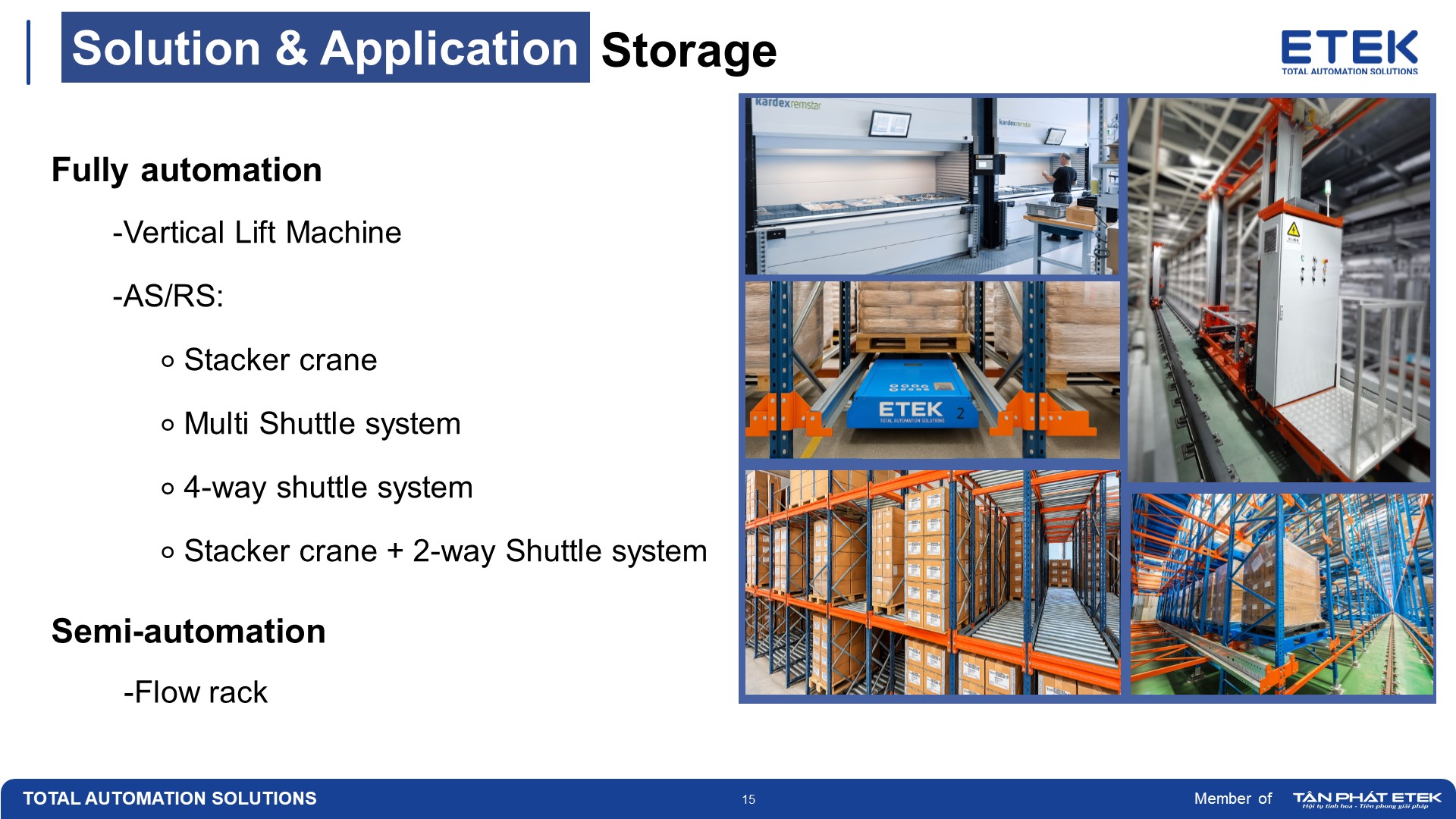
2.1. AS/RS Stacker Crane – Ideal for Large scale Warehouses
The AS/RS (Automated Storage and Retrieval System) uses stacker cranes that move horizontally and vertically along aisles between racks to store and retrieve pallets.
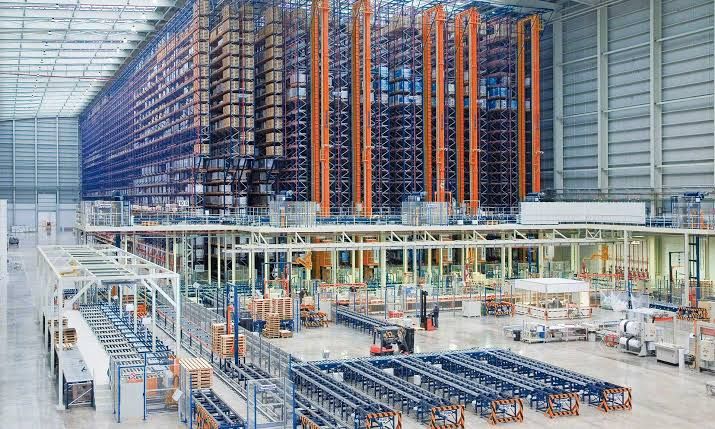
One of its biggest advantages is the ability to utilize warehouse height-often up to tens of meters – significantly increasing storage density. Its high accuracy and stable operation make it particularly suitable for industries such as automotive, food & beverage, and large distribution centers that handle high daily volumes.
2.2. Shuttle System – High-Density Pallet Storage Optimization
The Shuttle system uses automated carts that move within racking systems to store pallets deep inside the racks.
Compared to traditional racking, this solution significantly increases storage density by reducing the number of aisles. It is especially suitable for businesses handling large volumes of similar pallets and requiring batch storage, such as food, beverage, or cold storage industries.
2.3. 4-Way Shuttle – One of the Most Flexible and Advanced Solutions
The 4-Way Shuttle system is an advanced version of the traditional shuttle system. Its key difference is that shuttle robots can move in four directions (forward, backward, left, right), rather than being limited to a single lane.
With multi-directional movement and multi-level operation, this system allows for highly flexible warehouse design without being constrained by fixed layouts. Robots can also integrate with lifts to move between levels, forming a fully automated ecosystem.
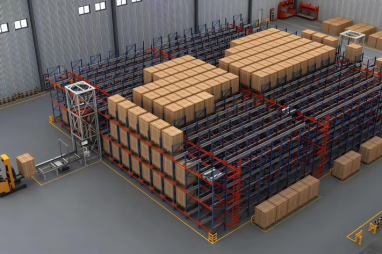
Its standout advantages include scalability, high throughput, and exceptional space optimization-making it ideal for e-commerce, modern logistics, and factories with diverse and frequently changing product portfolios.
2.4. Mini Load AS/RS – Optimized for Small Items and Cartons
The Mini Load system is a type of AS/RS specifically designed for handling cartons, trays, or small boxes. It uses high-speed mini stacker cranes capable of processing thousands of picking operations per hour.
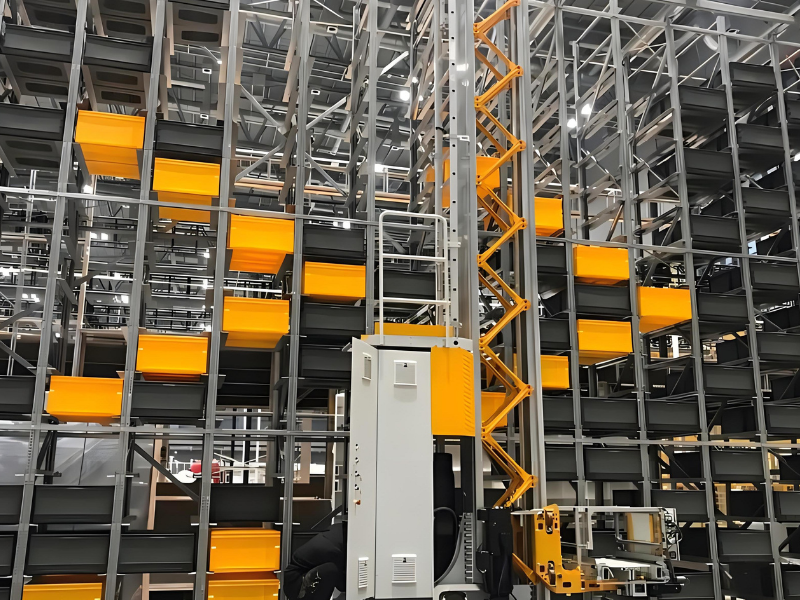
This solution delivers near-perfect accuracy while significantly reducing picking time compared to manual methods. It is widely used in electronics, pharmaceuticals, and manufacturing environments requiring fast access to large volumes of small components.
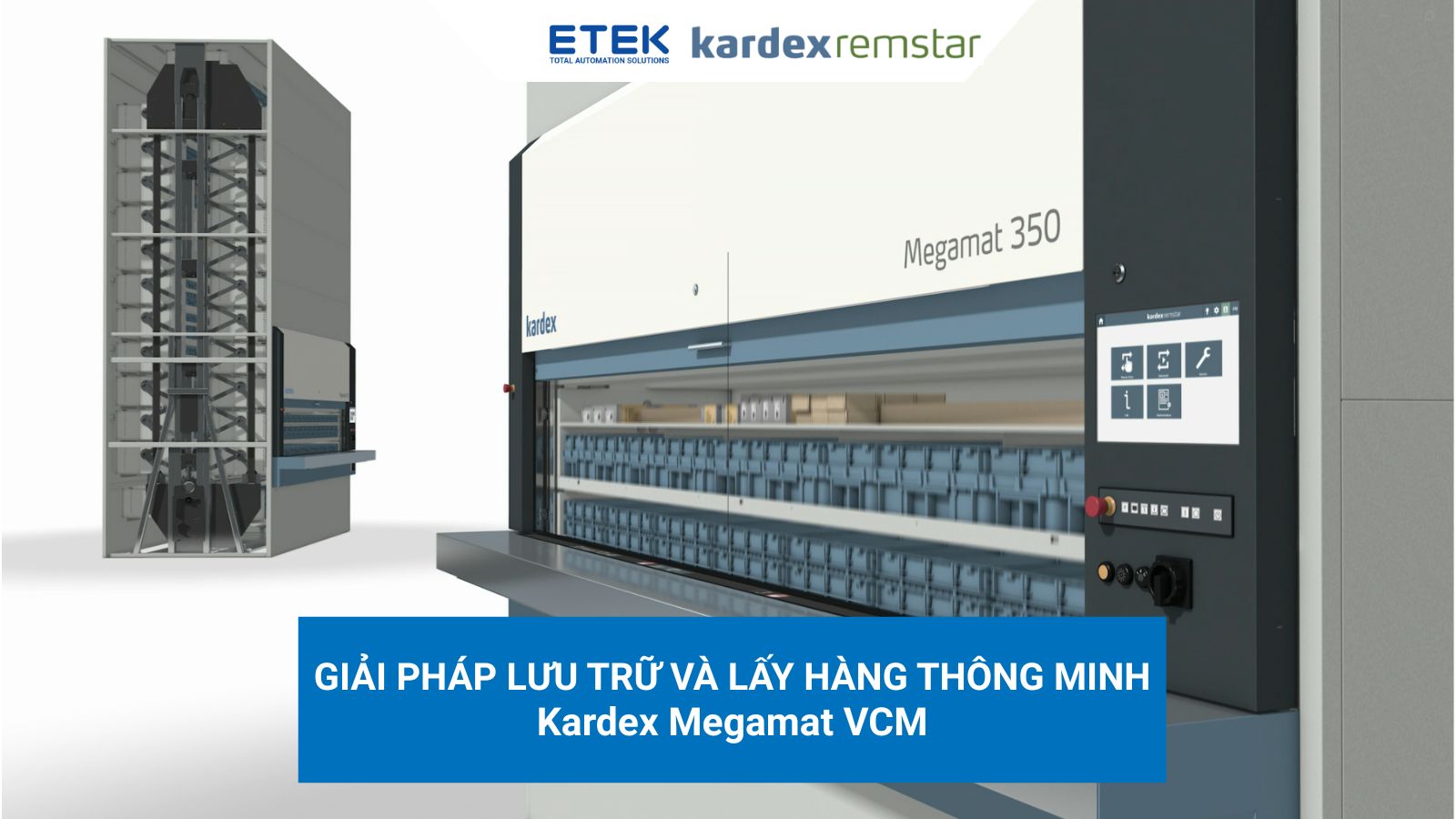
2.5. Vertical Lift Module (VLM) – Space-Saving Vertical Storage
A Vertical Lift Module (VLM) is a vertical automated storage system where goods are stored on trays that move up and down within an enclosed unit.
Its greatest advantage is maximizing vertical space, potentially increasing storage capacity by 70–80%. It also improves operator ergonomics by delivering items to an optimal working height.
VLM systems are ideal for spare parts storage, maintenance (MRO) warehouses, or businesses with limited floor space but strict inventory control requirements.
2.6. Vertical Carousel – High-Speed Continuous Picking
The Vertical Carousel operates on a vertical rotating mechanism, similar to a “rotating conveyor.” When an item is requested, the system rotates to bring the correct storage location to the operator.
This system offers fast retrieval speed, simple operation, and is well-suited for environments requiring continuous picking, such as spare parts warehouses, pharmaceutical storage, and technical service centers.
2.7. Flow Rack – Optimizing FIFO Inventory Flow
A Flow Rack system uses inclined racks with rollers or rails, allowing goods to move automatically from the loading side to the picking side using gravity.
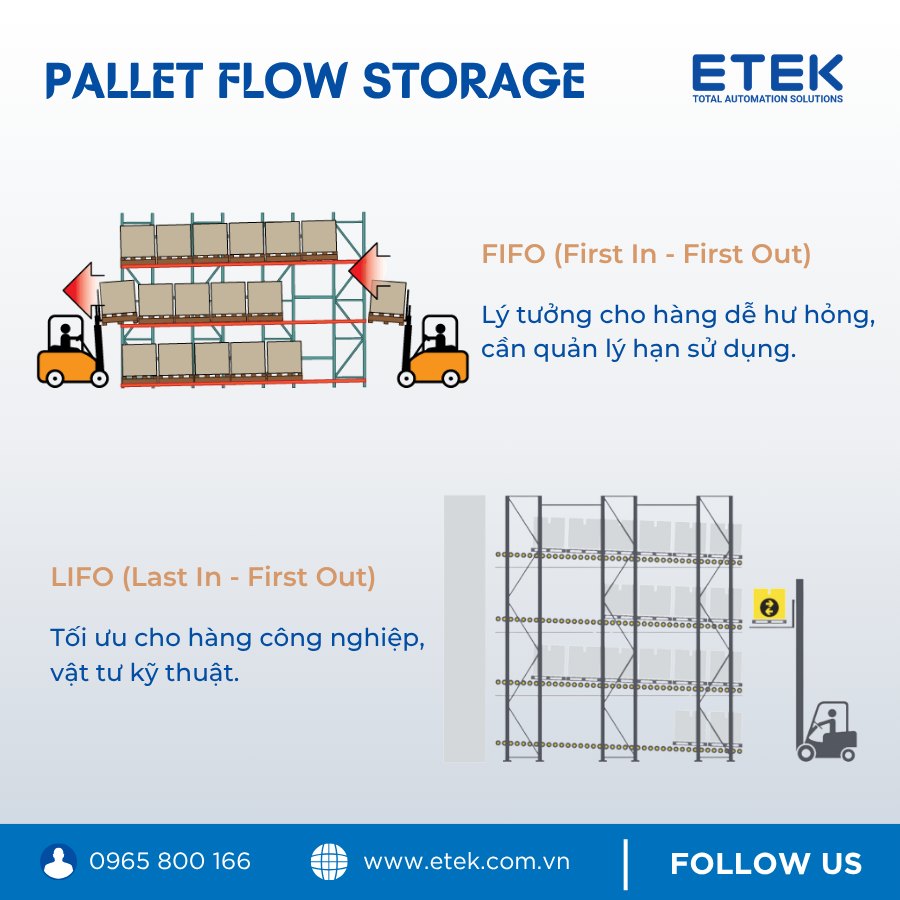
Although semi-automated, it is highly effective in maintaining the FIFO (First-In, First-Out) principle. It reduces operator workload and increases picking speed, making it ideal for production lines requiring continuous component supply.
2.8. Mobile Rack – Maximizing Storage Space
A Mobile Rack system consists of movable shelving mounted on rails, allowing racks to shift and create access aisles when needed. Instead of multiple fixed aisles, only one aisle is required.
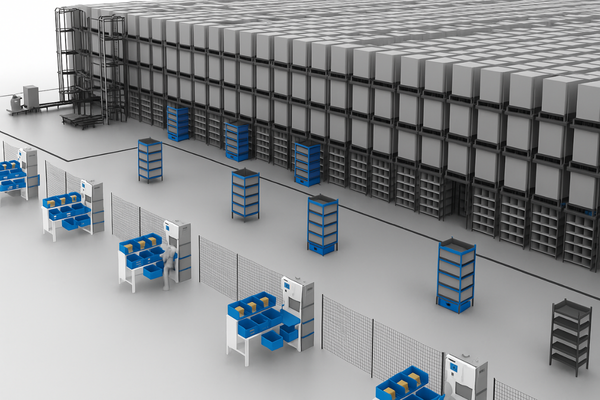
This significantly increases storage density and is especially suitable for high-cost storage environments such as cold storage or document archives.
Overall Benefits of Automated Warehousing
Investing in automated warehousing not only optimizes space but also transforms overall operations. Businesses can increase order processing speed, reduce errors, optimize labor costs, and enhance real-time inventory visibility.
More importantly, automated warehouses serve as a foundational element for building a Smart Factory, where production and logistics processes are seamlessly connected and intelligently optimized.