CÔNG TY CỔ PHẦN GIẢI PHÁP TỰ ĐỘNG HÓA ETEK | ETEK INTRALOGISTICS


Optimizing Intralogistics for Garment Factories through ETEK’s Raw Material Inbound and Finished Goods Outbound Conveyor Solutions
As the garment industry faces increasing pressure on delivery schedules, labor costs, and accuracy requirements, intralogistics has become a critical factor determining factory operational efficiency.
Customer Overview
The customer in this case study is a large-scale garment factory operating two separate warehouses for raw materials and finished goods. Each warehouse covers approximately 1,500 m², is designed with two floors, and handles very high daily inbound and outbound volumes.
Incoming materials mainly include fabric rolls, bundled fabrics, and packaged fabrics, with unit weights ranging from 20 to 90 kg. On the outbound side, finished goods consist of cartons of various sizes as well as hanging garments, which may also be packed in boxes. On average, the factory processes three to four 40-foot containers per day for both inbound and outbound operations. During peak seasons, the finished goods warehouse alone may handle up to nearly 30 containers per day. With such high volume and frequency, internal logistics play a crucial role in ensuring uninterrupted material flow.
Challenges
Before implementing ETEK’s solution, the factory faced several issues:
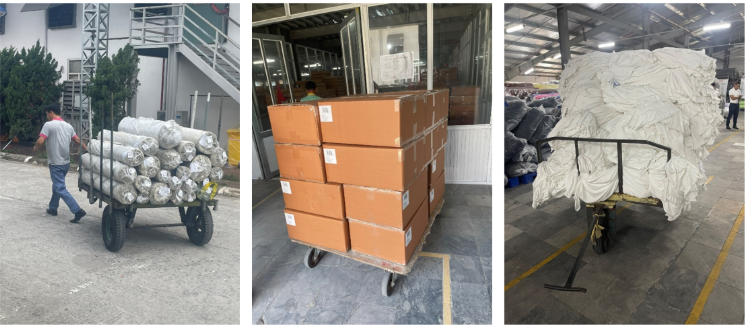
Operations relied heavily on manual labor and basic handling tools such as hand carts. After unloading from containers, goods had to go through multiple disconnected steps including manual lifting, manual pulling, sorting, manual counting, labeling, and inter-floor transportation. Each container required 10–12 workers, with handling times ranging from one to over two hours. This created significant labor pressure and made it difficult to cope with peak periods. In addition, the lack of mechanized support increased the risk of quantity errors and frequent congestion at warehouse docks.
Project Requirements
Based on these challenges, the customer set clear requirements: mechanize loading and unloading operations to reduce labor dependency, shorten container handling time, minimize errors, and optimize the warehouse layout—moving raw material storage to upper floors while concentrating finished goods storage on the ground floor. The solution needed to be flexible, scalable, and deployable without interrupting ongoing factory operations.
ETEK’s Solution
Based on on-site surveys and operational data, ETEK proposed and implemented a comprehensive intralogistics solution centered on raw material inbound conveyor lines and finished goods outbound conveyor lines. Instead of fragmented manual handling, goods are transferred directly from receiving areas into the conveyor system, seamlessly connecting different zones and warehouse levels.
For raw materials, straight conveyors combined with transfer conveyors and mobile unloading platforms enable efficient handling of heavy fabric rolls. The system integrates counting devices and sensors to control material flow in real time during transportation.
On the outbound side, the conveyor system is designed to handle both cartons and hanging garments, including accumulation roller conveyors, Z-shaped conveyors, and dedicated hanging conveyors. Finished goods are transferred directly from production or consolidation areas into containers, minimizing intermediate handling and ensuring a stable shipping rhythm. The entire system features a modular design, synchronized speeds across conveyor sections, and readiness for future integration with warehouse or production management systems.
Achieved Results
After implementation, the improvements were clearly measurable:
- A significant reduction in the number of workers required per container
- Loading and unloading times shortened by 30–40%, enabling better control during peak periods
- Integrated counting and flow control devices improved inbound and outbound accuracy, reducing errors and operational pressure
- More effective use of the two-level warehouse layout, reduced congestion, and noticeably improved workplace safety
This case study demonstrates that ETEK’s raw material inbound and finished goods outbound conveyor clusters are more than just transport systems—they form a robust intralogistics foundation that helps garment manufacturers standardize operations, optimize costs, and prepare for future expansion. It is also a key step toward automation and smart factory models in an increasingly competitive industry.